Grand Designs
Melb. art beat; plus Regional Galls

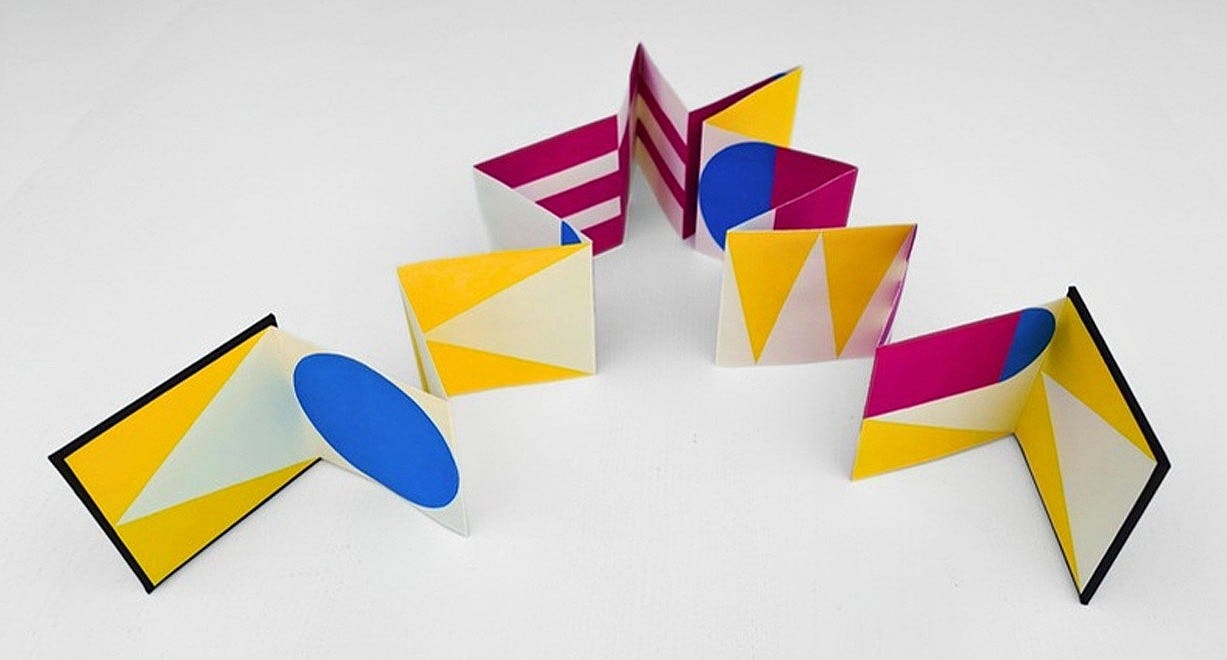
Stephen Tonkin - Konkrete Buchwerk, Berlin (2025)
Stephen Tonkin (Five Walls Gallery, 1st Fl, 119 Hopkins St, Footscray, until 30 May; www.fivewalls.com.au/archives/15573 )
Art Gallery of Ballarat (40 Lydiard St Nth, Ballarat; www.artgalleryofballarat.com.au )
Bendigo Art Gallery (View St, Bendigo; www.bendigoregion.com.au/bendigo-art-gallery )
Benalla Art Gallery (Bridge St, Benalla; www.benallaartgallery.com.au )
Stephen Tonkin’s compact show brims with enthusiasm in the project room at Five Walls Gallery. This young artist-designer visited Berlin last year to study collections of geometric abstraction and related design held by German museums. During his stay he made a pilgrimage to the city of Dessau in Anhalt, where he visited the Bauhaus museum and toured that historic design school, as well as seeing inside the preserved modernist homes of its famous teaching staff (they included Paul Klee, Wassily Kandinsky and Josef Albers).
For Tonkin that visit was a signal experience. Back in Berlin he speedily made the 1920s style word-paintings on show here, and, inspired by the Bauhaus’s book design program, developed graphic ideas for abstractions using folded paper. Since returning to Melbourne he has printed up paper sheets and made one version of those folded geometric abstractions.
In its short history the Bauhaus so transformed graphic design, product design, photography and architecture that there is no single Bauhaus style, but multiple styles across many fields. Stephen Tonkin is clearly interested in the introductory graphics classes taught by Johannes Ittens, Kandinsky and Klee over 1923-25, especially the ‘colour seminar’ Kandinsky jointly ran with Ludwig Hirshfeld-Mack. This became an opportunity for Kandinsky to speculate on possible correlations between the three modern primary colours (red, blue, yellow) and the three elementary shapes of Greek geometry (circle, square, isosceles triangle). He quizzed students on which colour was suited to which shape, having them draw related compositions. Kandinsky became so fixated with this form-colour question he conducted a public survey of Dessau, distributing a questionnaire to townspeople in which they had to colour-in blank shapes and write an explanation for their choices. I’ve witnessed some pretty zany things when teaching in art schools, but nothing to match Kandinsky’s colour survey.
Eventually Kandinsky decreed the circle must be blue, the square red, and the triangle yellow. His rule was then built into the curriculum, and another Bauhaus teacher, Herbert Bayer, ran up wall-size abstract murals demonstrating the theme in the school’s stairwell: ground floor blue circle; first floor red square; second floor yellow triangle pointing skyward. That form-colour rule has been a bane to art teaching ever since, many students and amateurs using it when making fumbling geometric abstractions (hobbyists too often think art comes down to following such recipes).
Tonkin exhibits two interconnected bodies of work. Hanging around the gallery are seven small word-paintings, all designed using a grid format, some in gouache on paper, some acrylic on canvas. Using a plain palette of Red, Yellow, Blue plus either White or Black, these sequential compositions show a word or short sentence (Artworks, Made in Berlin) set down using geometricised alphabet letters. They become progressively more abstract, with later word-paintings (For Kandinsky, Non-Objective) using Kandinsky’s colour-shapes, and so being tricky to read. Curiously, Tonkin is the fourth artist this year to exhibit semi-abstract work built up from stylised lettering. Is it co-incidence, or something percolating across many minds? (The others were Nick Selenitsch, Rebecca Jones and Helen Maudsley, all reviewed here in February.)
A second group of exhibits are experimental designs for an abstract composition which uses folded paper to stretch out an extended length. Compositional ideas are trialled in gouache, culminating in Studies for Abstract Bookwork (illus. below) which adapts the red-square, blue-circle, yellow-triangle Bauhaus format. That set of four serves as basis for the folded-paper abstractions (with added bookends) which Tonkin displays on several tables.
Effort has clearly gone into a hundred printed and folded versions neatly arranged together as a central exhibit. Yet to my eye Konkrete Buchwerk, Berlin (illus. above), the first hand-made attempt in gouache which concertinas across a plinth, is the quirky standout piece in this show. It has such an infectious inventiveness which compensates for what might otherwise have been a display of tame Bauhaus pastiches.
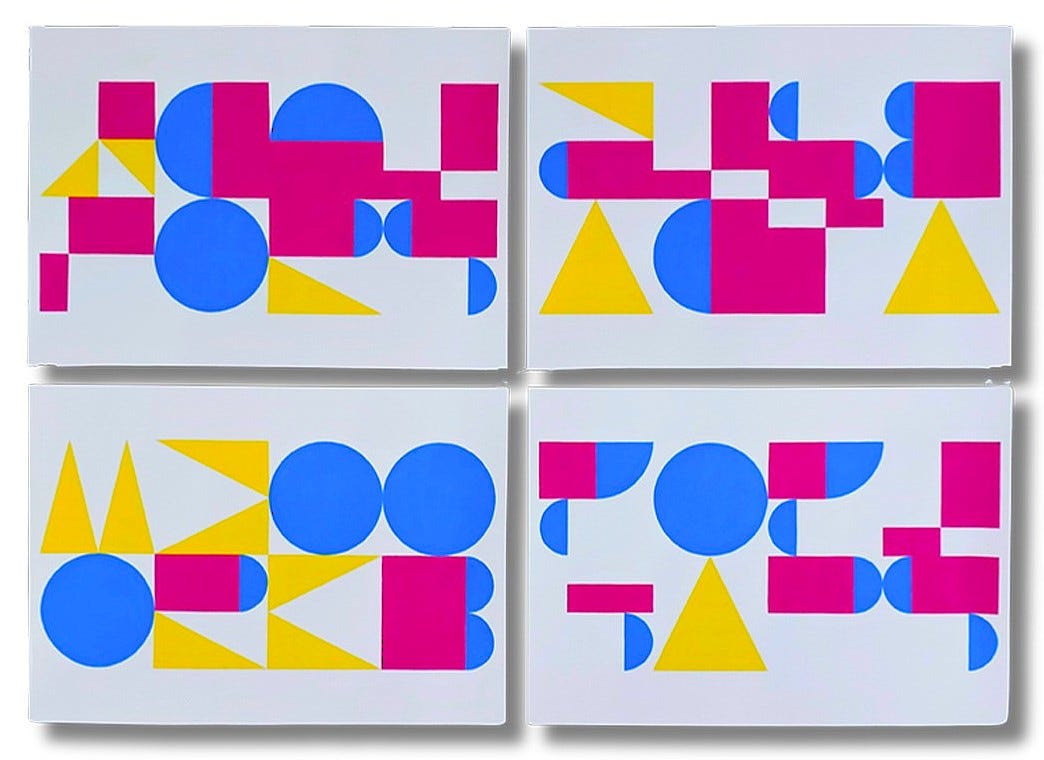
Stephen Tonkin - Studies for Abstract Bookwork (2025)
Ludwig Hirshfeld-Mack, mentioned above, who taught the Bauhaus’s ‘colour seminar’ with Kandinsky, came to Australia in the Second World War aboard the SS Dunera. In early 1942 he was appointed art master at Geelong Grammar School. Hirschfeld-Mack remained there for decades, teaching art and Bauhaus colour theory to a generation of Australian teenagers. Among them was the future museum director Daniel Thomas, who recalls:
The serene, quiet man - so fair that he glowed with the pale radiance of saints in stained glass windows - passed to and fro. One day I was looking at a book about Paul Klee. Hirschfeld noticed, and volunteered that he had known, and worked, with Klee, and with Kandinsky, whom I knew to be another modern master. I was electrified. Suddenly to see the stylistic connection between Klee’s art, illustrated in books, and Hirschfeld-Mack’s own framed watercolour hanging by the door to his flat was a first flash of art history, of the flow of forms and ideas through time and place
Hirschfeld-Mack was a member of John Reed’s Contemporary Art Society, exhibiting with it during the war years. He held several solo exhibitions in Melbourne during the 1950s, joining the stable of Gallery A.
The Curator’s Power Stance - ACCA’s CEO & Team members demonstrate how museum professionals use body language to put artists, gallerists, and visitor riff-raff in their place.
Gallery Re-opening Dates
Three of Victoria’s regional galleries—Ballarat, Bendigo, Benalla—are currently closed for redevelopment. Artist-readers have commented some gallery websites being rather vague on approximate dates for galleries to reopen; or on temporary exhibition venues; or on what construction work is being done. Upon checking, I’ve been able to confirm:
Ballarat - the historic gallery plans to reopen late in 2027.
Bendigo - staff advise they expect to be closed until early 2028.
Benalla - staff tell me they are working toward a late 2026 reopening.
‘Pop Up’ Regional Galleries
Benalla Art Gallery has ‘Pop Up Benalla Art Gallery’ in a shop at 75 Bridge St East, in the centre of town, where it has a program of exhibitions, talks, and members gatherings, for the duration of the main gallery’s closure. Check website for details.
The Art Gallery of Ballarat has ‘Backspace’ in a converted shop at 43 Mair St, directly behind the gallery, where it is running an exhibitions program of local artists and hobbyists during the main gallery’s closure. Check website for details.
Bendigo Art Gallery is holding a special Lego exhibition at the Discovery Centre, 7 Railway Pl (opp train station). The show will run until 29 Nov. 2026, and visitors do get to play with Lego. Tickets: Adults $20, Child & Conc. $18. The gallery also has weekly hobby art classes; and a monthly curator’s talk. Check website for details.
Grand Designs Underway
At the Art Gallery of Ballarat, local firm S.J. Weir commenced renovations of the historic art museum last month, April 2026. There was a delay in seeing work start at the state’s flagship regional gallery, which closed its doors to the public in March last year. Tenders on the extensive works required at the museum were not finalised and signed off until earlier this year. Grumbling over a lack of progress and bureaucratic ‘secrecy’, some local artists are annoyed their art gallery was shuttered and stood idle for 13 months. After stone-walling queries about the redevelopment—my own enquiries elicited only information that the place was receiving ‘future proofing’ and ‘interior upgrades’—Ballarat has now issued press releases and publicity detailing:
the museum’s aging internal environment systems (air conditioning, heating, ventilation) are to be replaced and upgraded to current professional standards
electrical cabling and switchboards will be upgraded to support the installation of larger exhibitions with a greater use of IT
there will be improved facilities to augment more complex travelling exhibitions loaned from interstate and overseas
the museum’s lighting system is being upgraded, including changes to UV filtering of 19th century skylights
linings are being installed to protect heritage walls throughout what is a valued historic building (it opened in 1887)
passenger and freight elevators are being replaced
Art Beat hopes this news will bring an end to emails, etc., about the gallery from Ballarat and district artists.
Bendigo Art Gallery closed late in 2025, likewise for essential redevelopment. Local firm Fairbrother Construction has commenced work toward adding a two storey wing beside the Federation period museum building. This will see added to the gallery:
a dedicated space for Dja Dja Wurrung cultural materials
a learning centre, comprising auditorium-theatre for lectures and events, teaching studio for school parties, and children’s gallery
a café and restaurant-cum-function centre
400 meters of additional display space upstairs for the permanent collection
a purpose designed gallery upstairs for international and interstate travelling exhibitions
The historic gallery has set up a section on its webpage where it publishes regular updates about the project, including photographs of work underway. Bendigo Art Gallery has suspended the regular Arthur Guy Memorial Prize for the duration.
Benalla Art Gallery closed late in 2025, for redevelopment. Putting in a restaurant has become pressing, the current café being temporarily set up within gallery exhibition space during the 1990s. Work at Benalla will include:
construction of a restaurant/café in an architecturally sympathetic extension to the 1970s purpose built museum
renovating the visitor entrance and lobby area
upgrading the gallery’s storage areas to current art conservation standards
upgrading curatorial work areas and staff facilities
the museum’s internal environment systems (air conditioning, heating, ventilation) to be brought up to current professional standards
bringing gallery spaces up to current museum standards, including improved facilities for travelling art exhibitions
enhancing the building’s carbon footprint by installing environment-friendly systems and materials where possible.
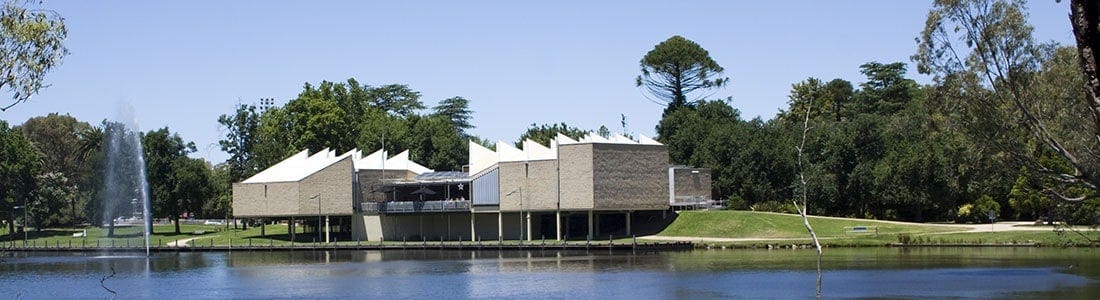
Benalla Art Gallery sited by the historic crossing of the Hume Highway over the Broken River