method of coping
Art Beat - Melbourne

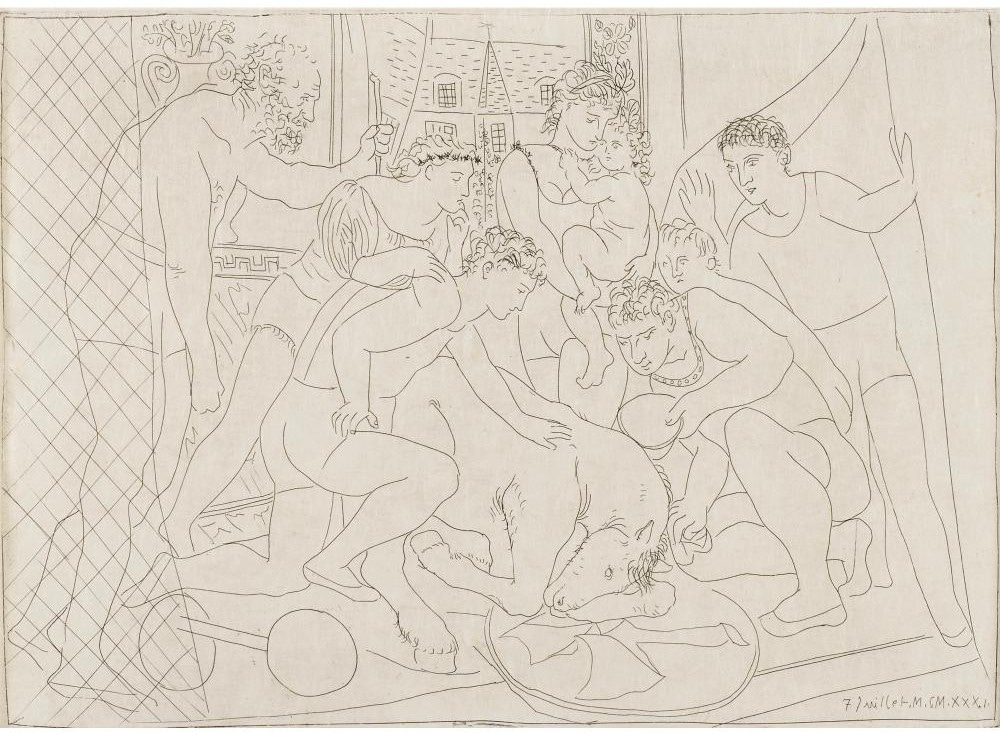
Pablo Picasso — Dying Horse, 7 July 1931
Marise Maas (Flinders Lane Gallery, 1st Fl, Nicholas Building, Cnr Flinders Lane & Swanston St, Melb., until 23 Apr.; www.flg.com.au)
Prints & Multiples (Leonard Joel, 2 Oxley Rd, Hawthorn; Viewing 17-19 Apr; www.leonardjoel.com.au)
» Due to petrol availability, for the time being I am using Public Transport to get around suburban galleries. Close to major railway stations, and also by tram lines, this week’s venues are easily visited.
In my ideal world there would be one Marise Maas painting on the wall in every medical waiting room I have used, instead of those sullen government notices. Just one. I’m serious. Her pictures never weigh you down with politics or theory. Instead they lift the spirits. They always do. Because they take such an infectious delight in the palpable lived-in world we occupy—a place of dishevelled kitchens, their tired steel chairs, clunky upright pianos, above-ground backyard pools, not forgetting noisy caged budgies—such irreverently domestic ordinariness, even when the paintings grapple with sobering emotions (her shows often are indirectly about family ups-and-downs).
Maas is a natural draughtsman. She has such a fluid manner when rendering whatever her eye settles upon. Her drawn world exudes the enjoyment of its own making, of those decisions which went into visualising each thing in a conscious quirky way. In art schools you see youngsters with these abilities often funnelled into Graphics programs (where they become bland illustrators), but Maas went through RMIT Printmaking, which didn’t interfere with the cheeky zap to her drawing. That said, there has always been a European stylised awkwardness to how she handles line and selects colour. This was even apparent in the first exhibits I saw from her—at Roar Studios in the 1990s—which smacked of CoBrA, of its oddball imaginings, mated with that oh-so-calculated roughness.
For this year’s exhibition the artist delivers 10 paintings (oil on canvas) and another 23 full colour drawings (acrylic and oil on paper). 3 paintings come in at 170 x 170cm, the rest at 100 x 100cm, while her drawings are 70 x 50cm. Musing over these playful works, I keep being drawn to two canvases, noticing how in their warmth and humour, there is sadness.
Low Level Hoarder is predominantly a dour black composition (illus. below). Designed as a fugitive grid, one can make out rudimentary patterns within subordinate sections. But the work’s abstract tenor is upended by an off centre section, which reads as a pale green tray filled with eye glasses, seventeen of them, each with garish red frames. Taking all in, the viewer recognises those dark rectangles suggesting a grid as probable containers filled with items accumulated by a ‘hoarder’, as the title indicates.
You’re inclined to laugh at those glasses. They look jokey. But Maas never fills her paintings with black. Something is up in this uncharacteristic moody picture. In a lucid intro for the show, Andrew Stephens writes that the exhibits quietly register the passing of the artist’s father, its emotional impact on family, what has been involved, like ‘the sorting out of all that was left behind…’ Here, in this picture, is that sorting process; with the colour black milked for its funereal overtones.
The Knot, which also holds my attention, shows a prancing gold circus horse under a theatre spotlight (it casts a shadow against a backdrop). Of course, local artists unfamiliar with Maas’s name will recognise her cartoon-like pony paintings. Those leggy flattened equines in gaudy lime fields have been paraded on Flinders Lane for a quarter century now (successive waves of my students have remarked on them). Yet these seemingly ‘lite’ decorative pictures are steeped in what is a significant rite of passage for many adolescent girls—owning and caring for a horse—which was a formative experience for the artist herself. This background underpins Maas’s ongoing horse imagery. It can be sorted into pictures of agisted horses doing typical horsey things; and other, more telling compositions on relationships where horses in spare settings are stand ins for people.
Keeping in mind the theme of a father’s death, in this show drawing and painting are a method of coping with the emotions. Titles convey much: Moving on (a mature horse on treadmill, a younger horse waiting its turn above), Slide on down (old horse wearing a blanket beside a children’s playground slide), The sun between us (two facing horses beneath an afternoon sun), while Get back on the wagon and Clocking on, clocking off are self explanatory.
The gold horse performing tricks before a spotlight in The Knot not only wears on its head a thick black plume, exactly like funeral horses that pulled hearses in former centuries, but Maas puts on its stomach a grey circle within which a single white thread has tightly knotted itself in a ball of tension. How many of us have had this same sensation in a time of emotional strain? An artistic self-image, The Knot is a direct expression of what it is to bear up, even as inwardly one struggles with grief.
Pablo Picasso’s master work Cheval Mourant (Dying Horse) certainly warrants a visit to the forthcoming print sale at Joels. To my eye the standout exhibit, it is executed in this modern artist’s controversial Neo-Classical style where figures and objects were elegantly rendered with a single contour line (illus. top.). Developed out of his long study of Classical Greco-Roman originals, this economical idiom was often used by Picasso in etchings, lithographs and other graphic work from 1918 onward.
Dying Horse is set in a small upstairs room, resembling a theatre stage, before a window giving a view of an urban French courtyard. Seven people are gathered around a horse which lies awkwardly on the floor, while to the left, behind a screening trellis, an older man stands and silently watches. Most artists will recognise these figures as recurring cast members within Picasso’s oeuvre. They are Saltimbanques, a family of acrobats, who first appeared in his Blue and Rose period pictures. They are shown comforting the horse, offering it a bowl of water. And its evident they have been rehearsing. Notice how the athletic youth at right is entering through stage curtains, while the kneeling acrobat before him and girl diagonally opposite are each attired in circus costumes. At the back of the group, the young mother with a toddler in her arms, who looks down with concern, also wears a decorative head-dress.
There’s not much hope for the horse. It has collapsed heavily upon the acrobats’ props, scattering them on the stage (notice the torn paper hoop). It may be bloodless, but the end has arrived. Meanwhile, the bearded voyeur standing behind that trellis, is a sculptor. He is an archetypal figure who appears throughout Picasso’s prints of 1930-34, indeed, scholars agree this voyeur-artist was often used as a self image. So his presence suggests this composition is an allegory on the artist’s imaginative vision.
Picasso made dozens of etchings annually over the 1930s. Of such quality that in 1937 the print dealer Ambrose Vollard, who had handled Picasso’s graphics for decades, proposed publishing a luxury edition of 100 choice etchings—the famed Suite Vollard which would be released on the French art market in 1950. The artist agreed, and Vollard went through all the plates, picking what he wanted. Dying Horse was not among the etchings selected, but examining the Suite Vollard I promptly spotted a cluster of closely related compositions.
There is a near identical sculptor-voyeur in another etching of 1931 (Vollard Plate 7), while a drypoint composition in November 1933 has four Saltimbanques with a horse (Vollard Plate 17). It shows a girl riding bareback beside a youth balancing on a ball, both in a circus ring, as two other acrobats look on.
Closer still are several etchings made over a single week in March-April 1933. They start with the etching dated 30 March which shows a nude sculptor-voyeur and his nude model-lover lying together while watching three acrobats performing somersaults (Vollard Plate 54), then a second plate that day shows the same nude couple gazing upon a life-size sculpture of a youth with horse (Vollard Plate 55). Looking closely we notice the model here has the same floral band around her hair as the young mother in Dying Horse. An etching plate Picasso made up the next day, 31 March, has the sculptor-voyeur and model lying nude together on a bed while contemplating a sculpture of a bull with two horses, one of them lying down dead (Vollard Plate 57). This was followed on 3 April with a composition showing the nude sculptor-voyeur absorbed in a sculpture of two fighting stallions, as his nude model slumbers beside him (Vollard Plate 64). Finally an etching on 5 April features a large solitary nude model, identifiable as Picasso’s lover Marie-Thérèse Walter, who looks upon a complex sculpture of a horse leaping upward with five acrobatic youths (Vollard Plate 66).
It baffles me that Ambrose Vollard did not include Picasso’s Dying Horse in his celebrated ritzy production. I’ve sighted the entire Suite Vollard etchings several times, and this work is technically, stylistically and thematically of one with the others flagged here. That said the dealer’s son, Lucien Vollard, is responsible for editioning this superb print in 1947. He exceeded his father in my view. Because where the Suite Vollard was printed using the durable Montval paper in a large edition of 300, Vollard fils had Dying Horse printed on the rare handmade Japon Nacré paper in an initial connoisseurs’ edition of 40 (the full edition was 102), Picasso then signing it himself in red conte. You can’t get better than that.
There are many quality prints by respected local and international artists (incl. Joan Miro, David Hockney, Donald Judd, Richard Serra, Claes Oldenberg, a Diane Arbus photo) which will be in the Joel’s pre-sale exhibition on Friday, Saturday and Sunday next week (see website for details). But I’m a serious fan of Picasso’s prints and drawings, and have not sighted before this historic work, a telling moment in the story of modern art, hence the enthusiasm expressed here.
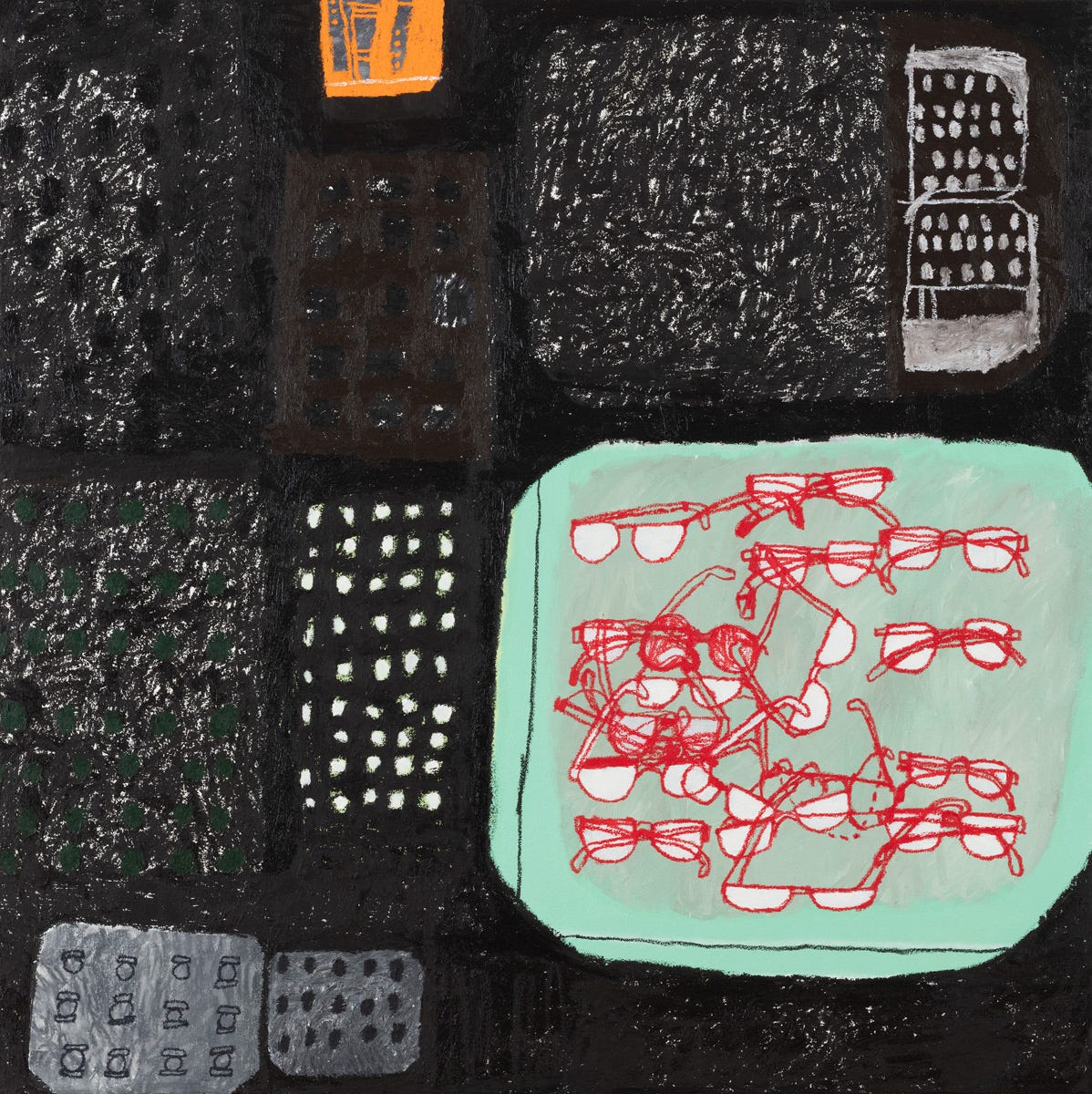
Marise Maas — Low Level Hoarder